
NAD+ 500mg
Essential coenzyme for cellular energy metabolism and DNA repair.
Key Benefits
serves as the essential substrate for SIRT1–7 enzymes that regulate metabolism, stress resistance, and longevity gene expression
fuels PARP enzymes that detect and repair DNA strand breaks; depletion during damage can be restored with supplementation
maintains the NAD+/NADH ratio critical for the electron transport chain, directly supporting cellular energy output
NAD+ levels oscillate with the circadian clock and regulate SIRT1-mediated transcription of core clock genes
Active Signaling Pathway
NAD+ serves as the essential substrate for sirtuin longevity enzymes and PARP DNA repair enzymes. As the rate-limiting molecule in these pathways, replenishment has cascading effects across every cell type in the body.
Investigated Pathways
Proposed Mechanism
NAD+ is a dinucleotide coenzyme that shuttles electrons in redox reactions (NAD+/NADH couple) and serves as a substrate for three classes of enzymes: sirtuins (SIRT1–7, deacetylases that regulate metabolism and longevity), PARPs (poly-ADP-ribose polymerases, DNA damage sensors), and CD38/CD157 (cyclic ADP-ribose synthases involved in calcium signaling). NAD+ depletion impairs all three pathways simultaneously.
Research Highlights
- NAD+ levels decline ~50% between ages 40 and 60 in human tissue — one of the most consistent biomarkers of biological aging
- David Sinclair lab (Harvard): NAD+ repletion via NMN restored vascular function and exercise capacity in aged mice to levels of young animals
- PARP activation during DNA damage can deplete cellular NAD+ by up to 80% — supplementation supports repair capacity
- 2023 human trial: IV NAD+ infusion (500mg) increased whole-blood NAD+ by 8× within 2 hours; subcutaneous injection achieves 4–5× increase
Research is at an early stage. Findings are preliminary and have not been replicated in controlled human studies.
For laboratory research only
All Research Systems →Human Body
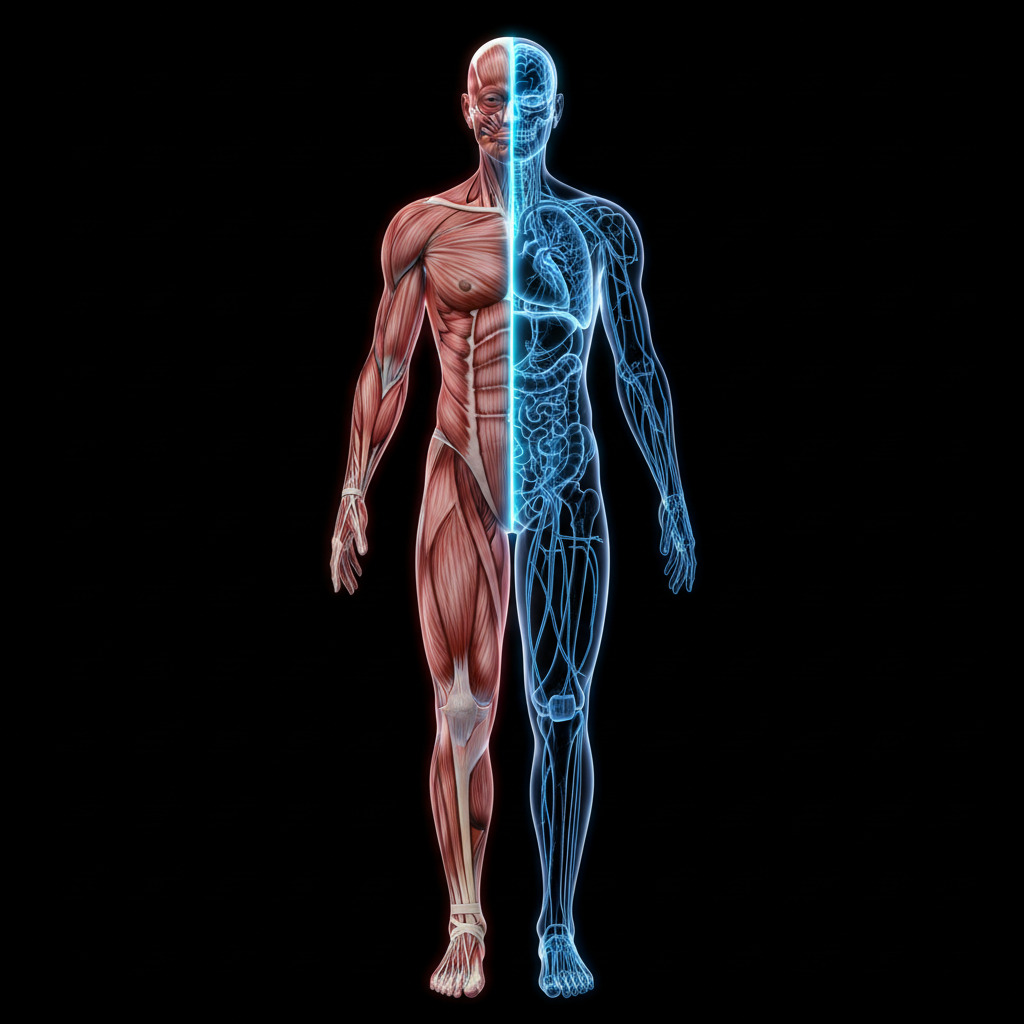
Research begins at the whole-organism level — studying systemic metabolic markers, energy expenditure, and physiological response to peptide intervention.
For laboratory research and educational purposes only.
Human Body
Research begins at the whole-organism level — studying systemic metabolic markers, energy expenditure, and physiological response to peptide intervention.
For laboratory research and educational purposes only.
For research use only — not for human consumption. No treatment claims.
Full Research Hub →Recommended Stacks
NAD+ 500mg is a key compound in these curated research stacks. Pair it with synergistic peptides for enhanced outcomes.
Longevity & Anti-Aging
Target the three root mechanisms of biological aging — mitochondrial decline, NAD+ depletion, and telomere shortening.
Detox & Glow Protocol
Glutathione 600mg + Lipo-C + NAD+ — deep cellular detox, liver support, and radiant skin from the inside out.
How long will one vial last?
Based on standard research protocols, here's exactly what to expect from a single vial — and when to plan your next order.
Vial supply estimate is based on standard research protocol volumes. Actual duration will vary based on your specific protocol design.
Scientific Background
Mechanism of Action
NAD+ is a dinucleotide coenzyme that shuttles electrons in redox reactions (NAD+/NADH couple) and serves as a substrate for three classes of enzymes: sirtuins (SIRT1–7, deacetylases that regulate metabolism and longevity), PARPs (poly-ADP-ribose polymerases, DNA damage sensors), and CD38/CD157 (cyclic ADP-ribose synthases involved in calcium signaling). NAD+ depletion impairs all three pathways simultaneously.
Clinical Context
NAD+ research has exploded in the past decade, driven by the discovery of its central role in sirtuin-mediated longevity pathways. IV and subcutaneous administration bypass the gut absorption limitations of oral precursors (NMN, NR), delivering NAD+ directly to circulation. The 500mg vial supports both single high-dose infusion protocols and multi-dose subcutaneous research schedules.
Research Highlights
- NAD+ levels decline ~50% between ages 40 and 60 in human tissue — one of the most consistent biomarkers of biological aging
- David Sinclair lab (Harvard): NAD+ repletion via NMN restored vascular function and exercise capacity in aged mice to levels of young animals
- PARP activation during DNA damage can deplete cellular NAD+ by up to 80% — supplementation supports repair capacity
- 2023 human trial: IV NAD+ infusion (500mg) increased whole-blood NAD+ by 8× within 2 hours; subcutaneous injection achieves 4–5× increase
Storage & Reconstitution
Key Studies
NAD+ repletion improves muscle function in muscular dystrophy and counters global parylation
Yoshino J et al.
NAD+ supplementation restored metabolic function and improved insulin sensitivity in aged and obese animal models.
PubMed →Chronic nicotinamide riboside supplementation is well-tolerated and elevates NAD+ in healthy middle-aged and older adults
Martens CR et al.
NAD+ precursor supplementation safely elevated whole-blood NAD+ and improved vascular function in aging adults.
PubMed →Skeletal muscle NAD+ deficiency and its role in aging
Elhassan YS et al.
NAD+ levels in skeletal muscle decline with age; supplementation restored mitochondrial function and exercise capacity.
PubMed →Pharmacokinetics
Bioavailability indicates how much of the compound reaches systemic circulation. Peak plasma is when blood levels are highest. Half-life determines dosing frequency — compounds with short half-lives require more frequent dosing to maintain therapeutic levels.
The volume of distribution reflects how widely the compound distributes into tissues. A higher Vd means the compound concentrates in tissues rather than staying in plasma.
Receptor Binding Profile
Deacetylase enzymes regulating metabolism, stress resistance, and longevity gene expression
DNA damage detection and repair; NAD+ depletion during DNA damage can be restored
NAD+-consuming enzyme involved in calcium signaling; major NAD+ consumer in aging
Electron transport chain function; NAD+/NADH ratio critical for cellular energy output
Side Effects & Adverse Events
- Flushing (IV — slow infusion rate)
- Nausea
- Injection site reactions
- Headache
- Fatigue
- Dizziness
- None documented at research doses
Contraindications & Interactions
Synergistic Compounds
NAD+ and glutathione are complementary cellular defense systems — NAD+ activates sirtuins and PARP while glutathione handles oxidative stress.
NAD+ 250 mg SubQ + Glutathione 600 mg SubQ/IV, 2–3× per week.
View Compound →MOTS-c activates AMPK while NAD+ activates sirtuins — complementary longevity and metabolic pathways.
NAD+ 250 mg SubQ + MOTS-c 5 mg SubQ, daily or every other day.
View Compound →5-Amino-1MQ inhibits NNMT to raise intracellular NAD+ in adipocytes; exogenous NAD+ provides systemic NAD+ repletion for synergistic metabolic effects.
5-Amino-1MQ 75 mg oral daily + NAD+ 250 mg SubQ 3× per week.
View Compound →Transparent Global Sourcing
Manufactured
Sourced through our manufacturing partner in China
Independent Testing
Analytical reports available from Janoshik Analytical
Batch Verification
Batch-specific COAs with online verification via janoshik.com
US Fulfillment
Orders fulfilled from the United States